Syntropy
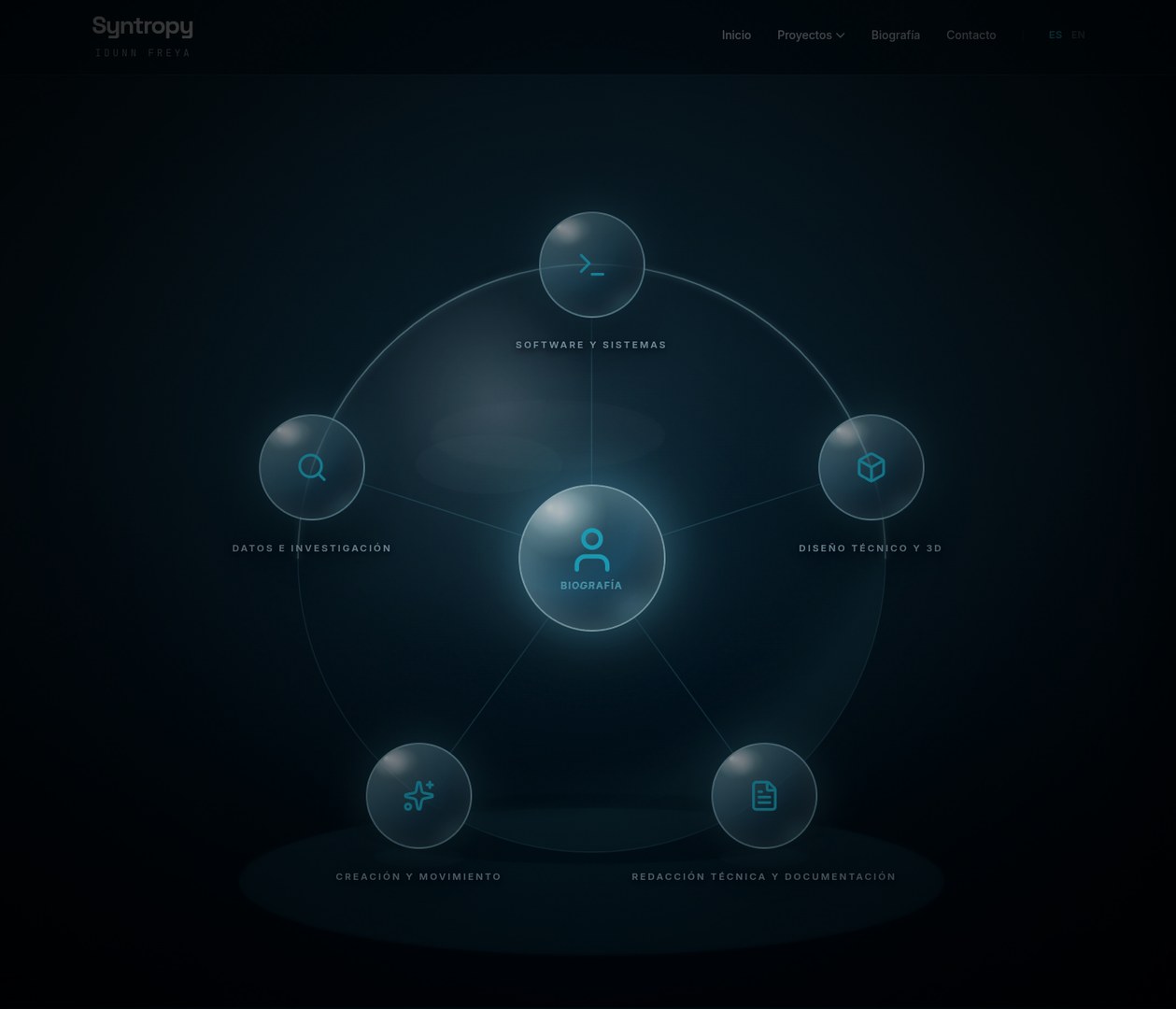
Professional web infrastructure designed and deployed end-to-end — backend, frontend, DevOps, security and SEO — as a cohesive system where every technical decision serves a real production criterion.
Technologies
Roles
Results and Achievements
Production system with 104+ tests, automated CI/CD pipeline, daily backups with 14-day retention, full bilingual SEO (hreflang, OG, sitemap) and custom analytics with no third-party dependencies.
Syntropy exists because no template solves the problem of presenting work that crosses disciplines without flattening its complexity. It is a complete web system — not a theme on a CMS — built to manage heterogeneous technical content (code, blueprints, video, 3D models, documentation) under a bilingual architecture with granular control over what is shown and to whom.
The name is deliberate. Syntropy is the principle opposite to entropy: order emerging from complexity. That is both the project's thesis and the profile it presents.
Context and origin
A multidisciplinary portfolio has a structural problem: its content is not homogeneous. Code, CAD blueprints, audiovisual pieces and technical documents do not coexist well in templates designed for image galleries or blogs. Syntropy is built from scratch because the problem demands it — not as a technical indulgence.
Challenge
No existing template solves the presentation of work that crosses disciplines without flattening its complexity. A standard CMS does not allow granular per-project visibility control, real bilingual content, nor management of heterogeneous formats (code, blueprints, video, 3D models, technical documentation) under a coherent architecture.
Architecture
Django 4.2 LTS with seven modular applications (home, sections, projects, bio, contact, legal, core), PostgreSQL as database, Nginx as reverse proxy and Docker for multi-environment containerisation. The frontend uses Tailwind CSS with vanilla JavaScript — no SPA frameworks because the content is fundamentally static and performance should not be sacrificed for convention.
Infrastructure and operations
- Deployed on Hetzner VPS with a dev → GitHub → production workflow.
- CI/CD pipeline via GitHub Actions, automated daily PostgreSQL and media backups with 14-day retention, security hardening with iptables/DOCKER-USER, rate limiting, honeypot and anti-spam filtering.
- Transactional email via Brevo with full DNS authentication.
Access control and lead generation
Not all work can be public. Syntropy incorporates a per-project visibility system that allows marking content as private and offering an access request form. This turns the portfolio into an active professional filtering tool: whoever wants to see the technical details identifies themselves first.
My role
End-to-end design, development and operation of the system: data architecture, Django application modelling, frontend with Tailwind CSS, CI/CD pipeline with GitHub Actions, security hardening, backup system, DNS and transactional email configuration, bilingual SEO and custom analytics. No external collaborators or preconfigured frameworks.
Lessons and evolution
Syntropy confirmed that the approach of building from structure outward is viable and sustainable: the system has been running in production for months without critical incidents. The decision to avoid SPA and keep vanilla JavaScript proved sound for this type of content.
- Next steps: Tailwind CSS compilation to remove CDN dependency, expansion of the project catalogue and refinement of the lead generation system.
Gallery
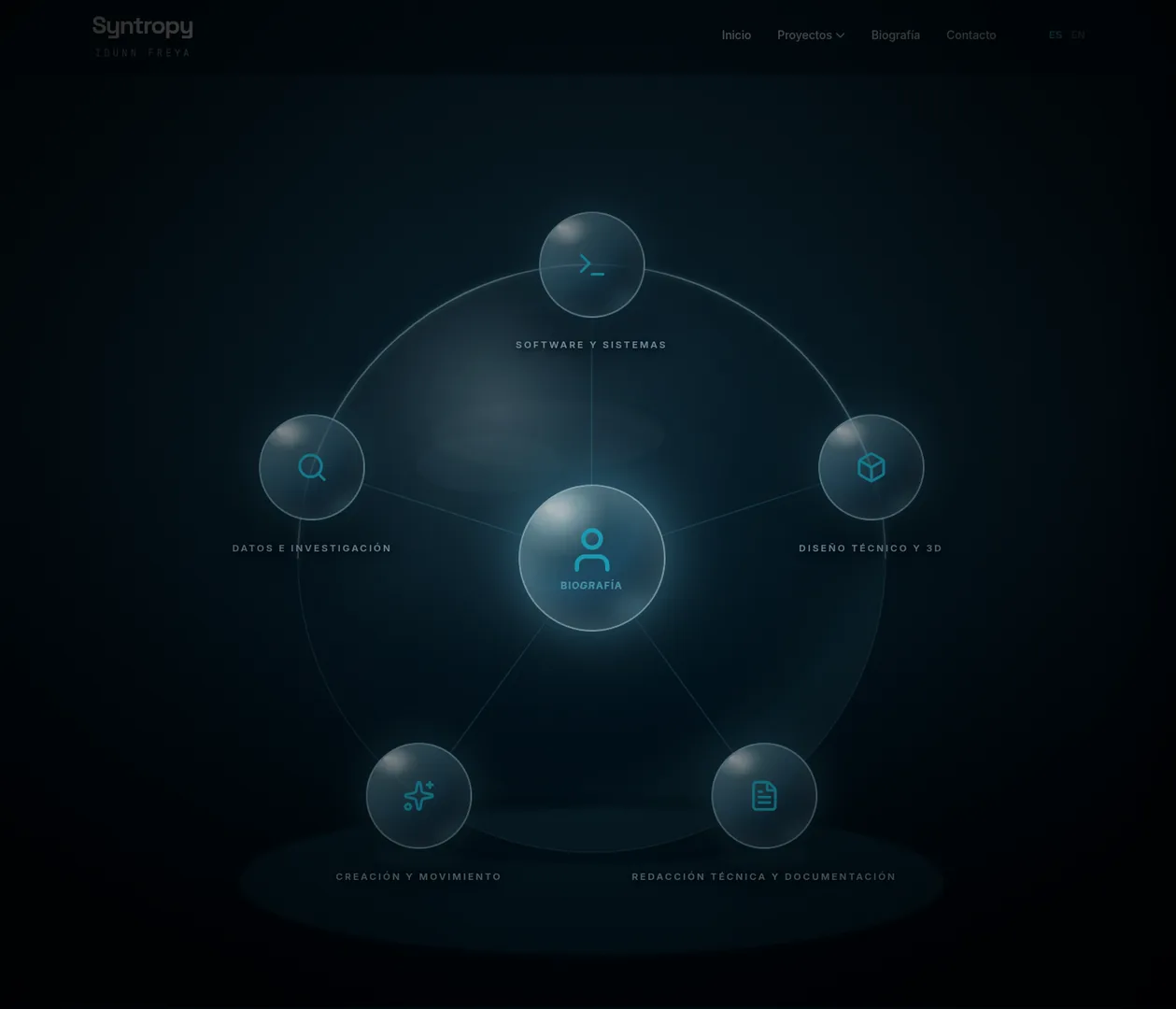
Interactive orbital system
Visual navigation by discipline from the home page
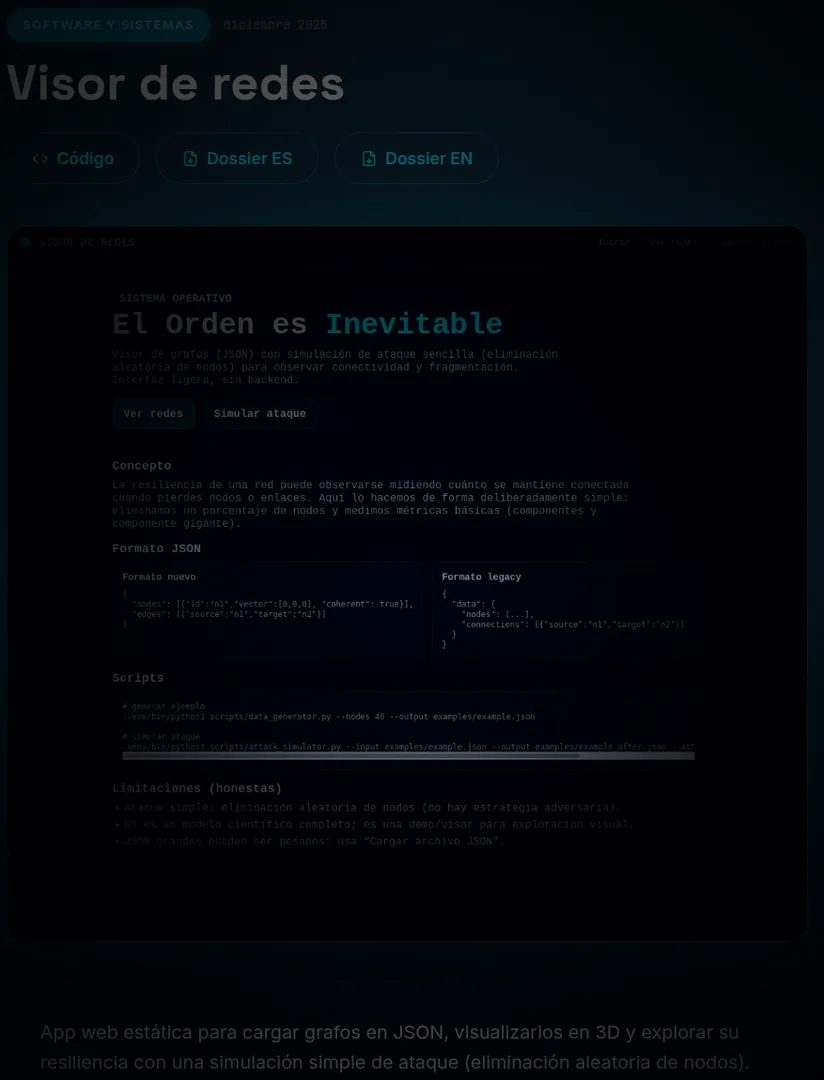
Project technical page
Modular narrative with content blocks and gallery
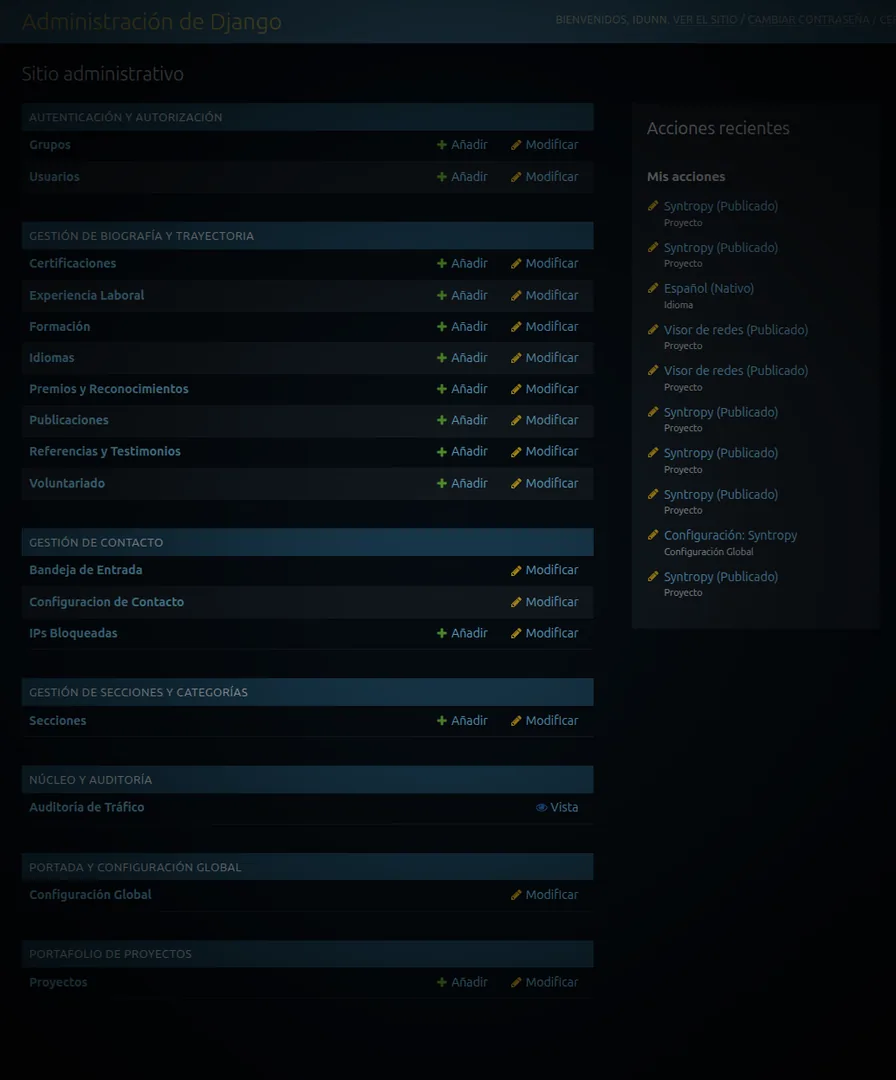
Admin panel
Granular bilingual content management and per-project visibility
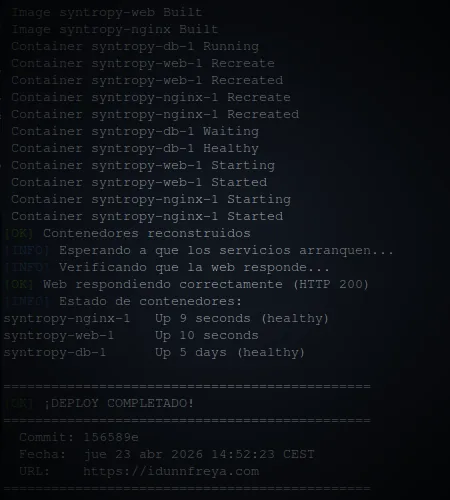
Deploy
CI/CD pipeline with GitHub Actions and automated deployment
Interested in this project?
If you need more technical information, additional documentation, or want to discuss a collaboration, feel free to contact me.
Request information